Wednesday, 3 July 2013

On Elevatorgate

slight detour from the EWTS conference notes, there's one coming later!

A friend asked me on twitter why women often feel uncomfortable at purely atheist/secular conferences, and then remembered the Richard Dawkins – Rebecca Watson ‘elevatorgate’ from 2011.

At an atheist conference, Watson had been talking about how shitty it is that women get sexualised at conferences like this. She was then hit on by a guy in the lift, in a situation that could very easily gone from bad to worse. After speaking up about this, she received a lot of criticism from Dawkins in particular, who wrote a satirical letter to a Muslim woman undergoing FGM (female genital mutilation), comparing her plight to Watson’s experience.

The problem with this is similar to the problem with the phrase ‘you shouldn’t be sad, because someone, somewhere has it worse than you’. Under this logic, nobody should ever be happy, because someone will always have it better than you. It’s comlpletely ridiculous. Obviously, on the grand scale of things, being sexualised and hit on in an enclosed space by a stranger is nowhere near as horrible an experience as FGM. But it doesn’t invalidate the experience, as Dawkins claimed it did. It’s worth noting that in this case, a man was telling a woman that she was overreacting when she was faced with an uncomfortable and overly-sexualised situation. This situation could have very easily not ended as it did, things could have gotten a lot worse, and Watson very easily could have been sexually assaulted. Dawkins trivialised a situation which he will probably never experience, but one which Watson will most likely experience a hundred more times.

This is just one example of why women are often apprehensive about atheist/secular conferences, even those aimed specifically at women. My experience was not on the scale of Watson’s, but again, it’s still valid. And while I received little negative backlash for feeling this way at the conference itself, the world of twitter took care of that afterwards. People who weren’t even at the conference. And whose only knowledge of the conference was through the MRA blogger (I refuse to plug him, also he’s a male supremacist dick), were telling me that I was overreacting, that I was being ridiculous, who couldn’t understand why I was upset. And because they couldn’t understand it, it was invalidated.

If women are going to continue to be involved in the secular movements, which is necessary for our empowerment, these spaces need to be safe, both from physical threats and belittlement of valid experiences.


Tuesday, 2 July 2013

On an Introduction to Empowering Women through Secularism

Annie Laurie Gaylor is the co-founder of the Freedom from Religion Foundation and editor of Freethought Today.

Freedom from religion foundations wouldn’t exist without the Catholic Church’s war on reproductive rights. Women have to save ourselves from theology-festered misogyny – the rising of women means the rising of us all.

In the wake of the child abuse scandals, Catholic Ireland must choose between women, children and their rights, or bishops and their wrong; between reproductive freedom or returning to the dark ages. Humanity should come before dogma, however as the tragic and unavoidable death of Savita Halappanavar last year proved, Catholic Ireland hasn’t reached this point of consciousness. A doomed fetus was placed above the life of a woman due to adherence to religious dogma. ‘But the Bible says abortion is murder’ many have cried, yet Gaylor notes that it doesn’t actually say this at all. What it does is provides ammunition for anti-women ideas, dooming them to be subservient, responsible for all of mankind’s sins though maternal servitude. Yupp, we get periods and the pain of childbirth in order to atone for sins on a global and timeless scale. Bit of a shit deal, in my opinion.

Gaylor goes on to tell us about her life growing up in Wisconsin before Roe vs Wade. Her mother was the one to go to if you had an unplanned pregnancy, and she would help you get to Mexico City for a termination. It was also illegal there, but considerably safer than back alley abortions in the US at the time. In 1971, Wisconsin’s first abortion clinic opened, and three weeks later a Roman Catholic attorney raided the clinic, stole records and appointment details, and removed a 17 year old girl from the clinic, despite being literally in the stirrups at the time of the raid. In response, Gaylor’s mother raised money to send the women who had appointments to New York for a termination.
Women were attempting to give themselves abortions using coat hangers and dying. Abortion was, and still is, a matter of life and death. No woman can call herself free until she has complete control over her body, until she can make the decision whether or not to become a mother. Yet legal abortion doesn’t mean much if it remains, or becomes, inaccessible; if it remains expensive, if clinics are shut down to the extent that entire areas are without a single clinic, if remaining clinics have strict regulations imposed on them.

The root of this bodily control is religious influence in governments and laws. Secularism (that is the removal of religious influence and dogma from all legislation, laws and governmental decisions, so that religious belief is a personal and private thing alone) is vital for women’s advancement, safety and control over their own bodies and reproductive healthcare choices. To empower women, we must disempower the Catholic Church, and all other religious institutions. Free thought is the best weapon women have in a world where religious dogma expects our silence and subservience.


We may not have a god on our side, but we have humanity and the enlightenment. Morality does not stem from theology, but from nature. 

On the Following Week's Worth of EWTS Notes

The Empowering Women through Secularism conference wasn’t, despite what the two posts below may lead you believe, a complete bust. Yeah, there were issues which really shouldn’t have been a thing, and it was incredibly disappointing, but I did learn a ridiculous amount about secularism, women and the links between the two.

There was an introduction, 6 sessions and a keynote speaker, all of which were fascinating and educational, and really made me think about my opinions and preconceived perceptions. I took nearly 30 pages of notes in my tiny, scrawly, note-taking writing and over the next week(ish), I’ll be writing up these and adding my opinions and afterthoughts. 
I'm also hoping that nothing else really horrifically disastrous happens during this time, because this is going to be like a calm writing period for me, as opposed to the weekend spent angrily hitting the keyboard as my blood pressure steadily rises.

Monday, 1 July 2013

On the Menz - EWTS Conference Part 2

TW: Transmisogyny, MRAs
I want you to imagine something for me. Imagine you are attending a conference entitled ‘empowering people of colour’. For the entire weekend, the discussion is about people of colour and how they’re discriminated against, and how they might overcome this. At the feedback session at the end, people, both white people and POC wonder why white people weren’t thought about, that white people need empowerment, even that to empower POC, white people need to be empowered also. There would be outrage.
Now, back to reality, and you’re attending an empowering women conference and a similar thing happens. You hear ‘what about the men?’ and ‘to empower women, we also need to empower men’. There is no outrage, only agreement. The few people who are a bit pissed off (and rightly so) are effectively told they’re not ‘real’ feminists, and there’s a ‘omg you obviously hate men!!’ attitude.
Had the Empowering Women through Secularism conference ended 30 minutes earlier, I would have left the hotel delighted. I would be able to say no, despite popular belief, atheist/secular spaces are safe and comfortable places for women, it was great. Alas, the feedback session did happen, and it began with the older woman who berated me and the other girl (her name is Anna, she’s a ledge) on Saturday (see On the Menz Part 1), saying we need to consider the men. That the suicide rate for Irish men is 4 times higher than for Irish women (a hugely important and legit issue) and that 90% of US inmates are male (quite irrelevant and also, not sexism because men commit more crimes, and more violent crimes, than women, so obviously will be more represented than women in prison).
Men are most definitely harmed by the patriarchy. I’m well aware of this. I took a ‘Men in Contemporary Society’ sociology module last semester and got an A. One of the reasons more men commit suicide than women is because they’re not encouraged to have support systems or talk about their feelings, because that’s a ‘feminine’ trait, and ‘feminine’ is synonymous with ‘bad’ and ‘weak’. Men are, for the most part, not given paternity leave. Again, this is due to what the patriarchy views as ‘feminine’. Women take care of children; it’s what they do, so why would men even want to do it? These, and many other legitimate men’s issues, are serious things which feminism also seeks to make right. But they do not belong in an empowering women conference. In order to make things better for men, we need to empower women in order to make ‘feminine’ traits (like feelings *gasp*) not a ‘bad’ thing.
Things went from bad to worse as the second person to give feedback took the floor. I’m not sure if she was one of the organisers, but I am fairly certain she was a volunteer, as she was in charge of handing out microphones during the weekend’s questions from the floor bits. She said that she was angry at the “misandrist language” used on Saturday (by myself and Anna, presumably), and then said (quoting a flag seen at Pride the day before) that if trans* rights are human rights, we should all “become transgender”.
Let that sink in a moment.
At an EMPOWERING WOMEN conference, someone used ‘misandrist language’ as though misandry was a legitimate thing. I, for one, would love to be told about the power structures and institutions women have which allow us the ability to oppress men. I would hand my CV in tomorrow.
On the weekend of Pride, at a conference about empowering women which seemed to forget that trans* women are also women and completely ignored the trans* community, members of the trans* community were fetishised.  Members of the trans* community, who arguably have fewer human rights than any other group, were part of a joke, made to be something that’s totes cool and fun to be! This is not ok, in any sense of the word.
This idea, that ‘we’re all human, let’s ignore differences’ was reiterated by many members of the audience who lamented that men were not discussed enough during the weekend. Yeah, we are all human, but not all of us are treated human or allowed to fully participate in society. To use the ‘we’re all human’ phrase ignores these disproportional disadvantages. An excellent metaphor is a running track. Those on the outside lanes have starting points farther away than those on the inside lanes, to ensure that everyone runs the same length. By saying ‘we’re all human, let’s give everyone attention’, it effectively makes all the starting points at the same point. For the sake of ‘equality’. Some people and groups need extra attention and support in order for society to be even a tiny bit equal. This is portrayed very well in the picture below. While the short person gets more boxes than the tall person in the right frame, it creates a more equal situation than when all three get the same number of boxes in the left frame.
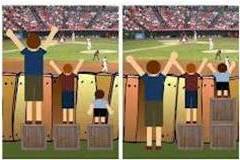
image
Overall, the conference was amazing. I met some utterly fantastic people and I learned so, so much. But I would not go to a similar conference again, unless it was organised by a feminist organisation. A friend turned down a ticket because she feels that secular/atheist conferences tend to not be overly friendly and comfortable spaces for women. This was my first and only conference of this sort, and from this alone, I feel that she is right.
My experience was not one shared by everyone in the room. Many people, both in the conference and on twitter using the conference tag afterwards, believe that it was acceptable to bring up men’s issues in this space, and that I was overreacting when I got upset. Beinga relatively new user of twitter I was shocked at the way in which I was attacked by people who weren’t even at the conference who sought to invalidate my experience. Having had to talk myself into coming at all on Sunday morning, I was already not in the best place mental health-wise. Perhaps my reaction, which was to nearly cry down the back of the hall in sheer disbelief, was not the most dignified reaction I could have mustered. But it’s what happened. It’s how my body tried to deal with everything. But my experience is still valid. My concerns are valid. I can only hope that the conference organisers agree.

On the Menz - EWTS Conference Part 1

Note - ‘the menz’ is basically the men who like/benefit/don’t see much wrong with the patriarchy. It’s intentionally incredibly patronising, and I use it to differentiate between men as a gender identity and those who are misogynist patriarchy loving dicks. Not all men are ‘the menz’, because I would have very little hope in humanity if this were the case.

So today I was able to attend the Empowering Women Through Secularism conference in Dublin due to being offered a free student ticket by a femmo friend/blogger (check him out, he’s fab). Lots of notes were taken and I’ll do proper posts on them during the week, but there was one massively depressing point during the day. The amazing Elida Radig was speaking and saying how we need to come together as sisters and not back down when we’re told we’re too loud etc. During the questions for that session, a young woman fangirled on behalf of all of us and made the point that we, as secular feminists, shouldn’t have to *ask* feminist men to help us - if they are going to call themselves feminists, they need to be proactive about it, they need to work hard to, we shouldn’t have to *ask* to be treated with equality and respect. 
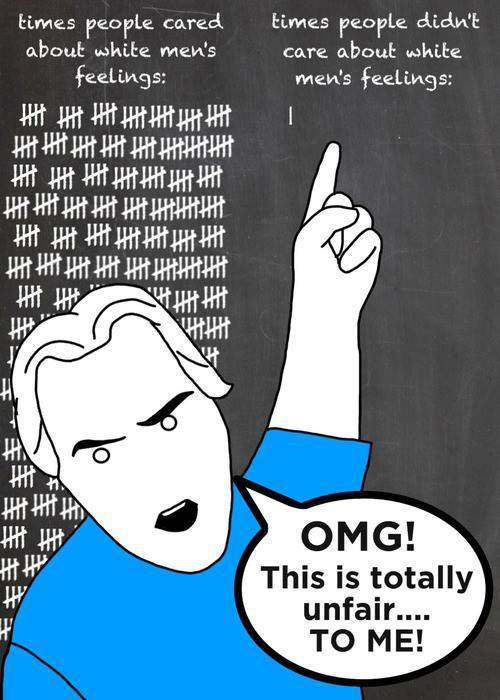
And then a man got up and said ‘not all men are like that, most of the misogyny *I* see is women being misogynistic against other women’. Classic ‘what about the menz??’ and I feel this picture is very appropriate (see also feminazi stole my ice cream).
image
When someone says but ‘not all [men/white people/straight people/dominant group known for oppression others] are like that’, they effectively prove that they do not get the point being made. All they heard was their group being attacked, and instead of admitting that there’s a problem, they turn on defensive mode and shift the blame. In this situation, a man attending an empowering women conference shifted the blame from men to women. Like really, why are you even here?
After the questions were over and we had a little break, I went up to the woman who had made the comment to tell her that she’s a ledge and to give her a cuterus I had drawn for her. We were mid conversation when an older woman who had been sitting in front of me came up and berated us for believing that we shouldn’t have to *ask* men who call themselves feminists to actually act like feminists. Apparently, we need to make feminism accessible for the menz so they’ll come to our side - we need to show them how the patriarchy is bad for men. I made the point that the ways the patriarchy harms men is often attributed to feminisim, a point she immediately dismissed. Basically, not only should men who call themselves feminists *not* call out their guy friends when they contribute to rape culture/lad culture/general sexism, they shouldn’t be expected to be involved in feminism unless it directly impacts them as men. They shouldn’t want to be a feminist because the patriarchy adversely affects other human beings, if they don’t know that it’s bad for them, they’ll never be involved. 
Not only was this incredibly offensive, but it was shocking too. To hear this from a woman who, I presume, identifies as a feminist, at what is a feminist and secular conference, was the last thing I had anticipated. Again, I was wondering why she was there, not because she shouldn’t be there, but because she holds views which are at such odds with feminism. She essentially told me and another young woman that our belief that male feminists should be feminists for the good of all people, not just their own gender, was wrong. That our belief that young men who are feminist and feminist allies should be active, regardless of whether that activism is directly impacting their lives as men, is wrong. That we, as secular feminists, need to make room in feminism for men. And despite the truly wonderful day and all the amazing, inspirational speakers, I left the conference slightly more disillusioned than when I walked in that morning.

On the Bechdel Test

This is a (slightly edited for blog purposes because Harvard referencing doesn’t really work for blogs) paper I wrote for my Men in Contemporary Society class last semester on ‘Growing up Masculine’. It got an A and I actually really like it, so I feel that it’s fitting for here too. Also all this weekend I’m attending the Empowering Women through Secularism conference so wont have time to write new material. 
While there are many factors which influence how boys ‘grow up masculine’, or are socialised into hegemonic masculinity, this paper will focus primarily on how movies and other similar media teach masculinity, concentrating on the Bechdel Test (or Bechdel-Wallace Test). 
Movies and TV shows are often a dominating aspect of a child’s life. There are few children growing up in Ireland without a TV, and many will go to the cinema or watch movies at home. With a decline in reading among young people, movies and shows are often the way in which children learn about the world outside the family and school, and their allure can cause their messages and views to override those taught at school or at home. 
The Bechdel Test was first developed in a 1985 comic strip called ‘The Rule’ and its premise is simple: in order to pass, a movie/show/novel must have two (named) female characters who interact with each other at some point, and their conversation must be about something other than a man. The idea behind this is to ensure that there are at least two female characters in the story who are relatively developed and complex. For the purpose of this test, gender identity, rather than biological sex, is the defining factor, as such, members of the trans* community who identify as female are included in the list of female characters (despite the lack of trans* characters in pop culture media). While it seems like an easy test to pass, very few of IMDB’s top 250 movies pass (including many with female protagonists), along with only a small number of movies released in the last few years, with very few box office hits passing the test. While this obviously impacts the way young girls are socialised into adulthood, it also affects young boys. The message which far too many movies and shows portray is one which reinforces the idea that women’s lives not only revolve around men, but that they remain the stereotypical ‘damsel in distress’ we remember from fairy tales, or the object of affection which the hero of the story ‘wins’ after overcoming some internal or external struggle. This in itself reinforces the idea of ‘ownership’ of women by men among young children, as well as their supposed simplicity and frivolity. In her book ‘One Dimensional Woman’, Nina Power notes that “if the contemporary portrayal of womanhood were to be believed, contemporary female achievement would culminate in ownership of expensive handbags, a vibrator, a job, a flat and a man”, and this trait isn’t isolated to Bechdel Test failures.
Since, according to R.W. Connell “masculinities are constructed, over time, in young people’s encounters with a system of gender relations” and “the configurations of practice associated with the social position of men”, this leads on to the way in which young boys are directly taught masculinity and manhood through movies and shows, just as young girls are arguably taught femininity through the Disney princess concept. Hegemonic masculinities are reinforced through the portrayal of boys and men – as the tough man, the brave fighter, the hero who overcomes the struggle on his own. As such, How Movies Teach Manhood (a TED talk by Colin Stokes which can be found here and well worth a watch) notes that there’s little room left for “other relationships and other journeys”. Although this hero character is often ‘rewarded’ with getting the girl in the end, it is not always the focus of his journey. These heroes/protagonists are often seen to be good role models for young men, which further reinforces the hero complex aspect of hegemonic masculinities. While the move away from the focus on violence and fighting among male characters is a welcome relief, even the shy, outcast boy who we see more and more of in pop culture reinforces hegemonic masculinities. They struggle on alone, choosing the ‘brave’ route of individual accomplishment over their setbacks, rather than asking for help or co-operating with others in order to ease their load. However, co-operation and asking for help is a trait associated with female characters in supporting roles and protagonist roles. 
Scheiner-Fisher & Russell, in their paper about using historical films to promote gender equity, admit that “often when women are included in a film for the sake of simply having a female in the film, she is relegated to a stock character role” (also known as the ‘Smurfette Principal’), most often cast as the love interest, ‘dumb blond’, nurse, tomboy, or ‘bad girl’. There is a problem in this way of teaching masculinity through film when we do not present young boys, and men in general, with female characters who are strong, relatable and complex. Through movies and shows which fail the Bechdel test, and which promote the ‘lone, brave hero’ male character trope, we are teaching a certain type of masculinity, one which reinforces patriarchal and ‘macho’ behaviour. Debbie Ging  states that many young men “understand images of hypermasculinity and misogyny not as parody but rather as masculinities with subversive or subcultural appeal”. As such, these ideas often win out those which acknowledge different ‘types’ of masculinity and being masculine, and those which provide both genders with strong female role models. 
Teaching masculinity, through any channel, needs to focus on how men interact with other men, as well as with women. Hegemonic masculinity, typically, ignores the ability of women to create meaningful ideas and contribute to conversations, merely reducing them to objects of desire or focusing on their reproductive role as mothers. While this view is obviously harmful to women, it also affects the development of masculinity in a harmful way, most notably through reinforcing discriminatory behaviours and placing less emphasis on co-operation and the importance of seeking help. 
Despite the increasing equality between the sexes in real life as opposed to the fantasy of film and TV,  Ging is concerned that “regressive images of masculinity might be doing more than merely lagging behind a more progressive reality”. How Movies Teach Manhood (2012) shows us that movies and other media are doing a relatively good job at teaching girls how to “defend against the patriarchy”, but they’re not doing the same for boys. The patriarchy affects both sexes in negative ways, and since there is no model for boys to rebel against this discrimination, the way they learn masculinity and grow up masculine is continually impacted upon in a negative way by movies and similar forms of media.

On Schrodinger’s Douchebag

Schrodinger’s Douchebag: make offensive statement, then decide whether or not you were joking based on the reactions of people around you.
The vast majority of vocal or active feminists will, at some point in their lives, have encountered a Schrodinger’s Douchebag.  These lovely people, usually DMAB guys, tend to hijack posts that you might write about issues you’re passionate about and have strong feelings about.
Basically, they act like assholes. They argue against your points, usually using incredibly racist/sexist/ableist/generally offensive ideas in an attempt to undermine your position. When called out on their shit, they either stand by it or say ‘I was only kidding’/’learn to take a joke’/’I was just doing this to wind you up’. However, in the same way it seems impossible to know whether Schrodinger’s cat is alive or dead, it also seems largely impossible to know whether the people acting like douchebags are *actually* bigoted douchebags, or doing it because they find it hilarious to get someone (justifiably) angry. But just as Schrodinger’s cat is actually both alive and dead, these people are both finding joy in your frustration for the lolz and douchebags. There’s no real distinction between the two. Even if their excuse is that they were doing it just to get a reaction and they don’t actuallybelieve what they’re saying; what purpose does that serve? Why do they find it entertaining to enrage you by acting like a douchebag? Because they aredouchebags.
If we don’t get pissed off, if we don’t rise to their offensiveness, they get away with it. They get away with making offensive statements and they will more than likely continue to make them. Yet when we do get offended, as is inevitable, we’re told to ‘just calm down’, sure ‘it’s only a joke’. But it’s not. People who find it entertaining to be offensive to get a reaction aren’t ‘just joking’. They’re doing something intentionally which they *know* is wrong and offensive, and they’re just annoyed that they’re getting called out on it.
I most recently experienced a Schrodinger’s Douchebag alongside some mansplaining. Mansplaining, for those of you who don’t know is, according to the delightful Urban Dictionary definition, “condescending, inaccurate explanations delivered with rock solid confidence of rightness and that slimy certainty that of course, he is right, because he is the man in this conversation”. Basically, the menz *always* know more, even if the woman* they’re mansplaining is an expert in that field, and he isn’t.
Anyway, I had a really shitty lecture (Men in Contemporary Society) in which the lecturer said that relationships are always unequal and the poor menz are under pressure from us mean horrible women to  bring more equality and trust to the relationship, which leads to crisis and the high rates of suicide among young men. This pissed me off, and I took to Facebook to complain. A guy, who I hadn’t seen or spoken to in like 5 or 6 years (we had gone to primary school together) decided to explain what the lecturer actually meant, despite not being in attendance in that class, the course, and who has no background in sociology or women/gender studies. After going on about how us wimminz just play games and he knows this because 90% of his friends are women, he’s clearly not enjoying being given out to by me and some femmo-friends, and admits he was just “trying to wind Becca up” and he isn’t really a misogynist, he just says misogynist things to get a reaction.
In these situations, it is probably easier and better for your blood pressure to just let it go and be like ‘oh, ok’, but this tends to do more harm than good. These guys aren’t necessarily horrible people, they’ve just grown up in a society which holds that this kind of behaviour is acceptable and when women react to Schrodinger’s Douchebag’s, we’re labelled as ‘crazy’ and ‘over-reacting’. Calling these people out on their shit is what, hopefully, begets change. They might realise that what they’re doing isn’t actually alright, or think twice about being an asshole for the lolz next time. Or they might actually be misogynistic assholes, in which case I recommended a large glass of wine and pictures of cute baby ducks to remind you that the world isn’t as shit as it sometimes seems.